09. Bank statements: what deserves a closer look?
Try it
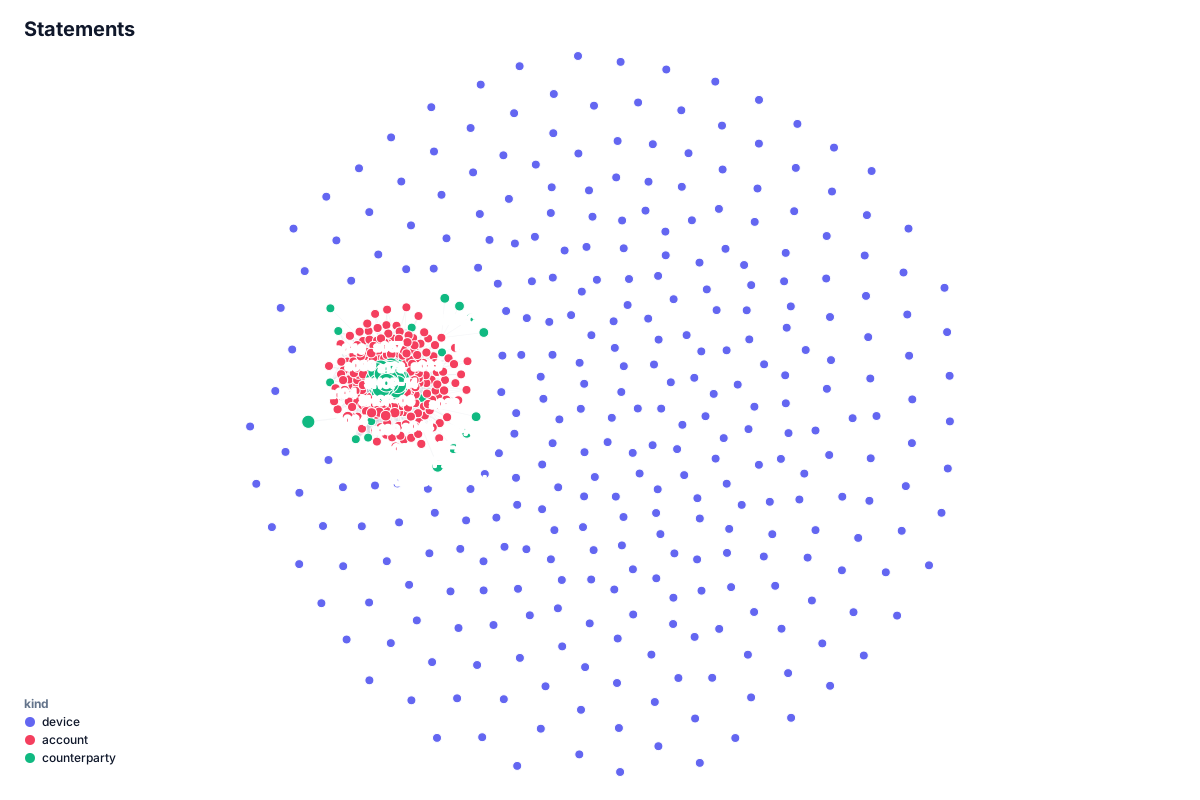
The question: in six months of bank statements, which accounts behave in a way worth investigating? And once something turns up, how do I get back to the transactions in my own records?
This is the kind of question anti-money-laundering and fraud teams ask every day. The data here is synthetic: 200 customers with salaries, shopping and money sent to friends, plus a few behaviors planted on purpose. tareco describes what it finds in neutral network terms; what counts as suspicious, and which limits and lists apply, is your call.
The data
statements.csv: one row per entry on a customer's statement (15,467 rows).
Money out is negative.
| transaction_id | account | date | counterparty | counterparty_country | amount |
|---|---|---|---|---|---|
| T000001 | a001 | 2026-01-01 | SHOP-22 | Northland | -85.38 |
| T009038 | a017 | 2026-04-13 | PI-ACC-3 | Palm Isles | -9901.16 |
customers.csv: who each account belongs to.
| account | occupation | monthly_income | city |
|---|---|---|---|
| a001 | cleaner | 1660 | Denver |
logins.csv: which device each account logs in from.
| account | device |
|---|---|
| a001 | dev-a001-phone |
Run it
python examples/recipes/09-statements/statements.py
Step by step
1. Look at the table first.
tareco.check("statements.csv", account="account", counterparty="counterparty")
Nothing to fix in 15,467 rows.
Real exports carry placeholders ("N/A", "0", "UNKNOWN") that tie thousands of
unrelated rows to one fake account, the same id written two ways ("123" and 123),
copied rows and dates nobody can read. check lists each of them with how many
rows it touches, before any of it reaches the graph; skip=["N/A"] leaves such
ids out when loading. From the terminal: tareco statements.csv --account account
--counterparty counterparty --check.
2. Load the statements.
g = tareco.Graph("statements.csv", account="account", counterparty="counterparty",
                 kind="transfer", nodes="customers.csv", keep=True)
accountandcounterpartyname the two sides of each entry; the sign of the amount says which way the money went. A link always goes from who paid to who got paid, with a positive amount.- When both accounts are customers, a transfer shows up twice: money out on one statement, money in on the other. tareco counts it once, from the side it left.
- Statement holders become nodes of kind
account; everyone else (shops, employers, accounts at other banks) becomescounterparty. keep=Truekeeps the rows behind every link, so each finding can take you back to the transactions.
3. Another kind of link: devices.
g.add_links("logins.csv", source="account", target="device", kind="uses")
<Graph directed, 573 nodes, 7645 edges>
{'links': {'transfer': 7303, 'uses': 342}, 'nodes': {'account': 200, 'counterparty': 62, 'device': 311}}
Logins join the same graph as links of their own kind. A login carries no money and has no direction, so tareco keeps it apart from the transfers: the flow analyses below only look at transfers, and the devices can still tie accounts together.
4. What it shows. Among the lines of g.explain():
- Links: 7,303 transfer and 342 uses. Nodes: 311 device, 200 account and 62 counterparty.
- a023 receives from 6 nodes and passes almost all of it on to 32 (207,767 in, 173,508 out).
- 4 account nodes share dev-77 (device).
- a017 sent 8 transfers just under 10,000 within 5 days (2026-04-13 to 2026-04-18), to 4 receivers, 9,434 to 9,901 each.
- a142 sent 7 transfers just under 10,000 within 3 days (2026-05-18 to 2026-05-21), to 3 receivers, 9,436 to 9,945 each.
- a055 sent 85,000 to ART-DEALER-W on 2026-03-14, 819x what it usually sends (104).
- a023 has monthly_income 2,060, 67x lower than the median of the 5 nodes it deals with (137,780).
Every planted behavior shows up without asking. The rest of the recipe looks at each one.
5. Many amounts just under a limit.
g.splits(limit=10_000, within="7 days")
- a017 sent 8 transfers just under 10,000 within 5 days (2026-04-13 to 2026-04-18), to 4 receivers, 9,434 to 9,901 each.
- a142 sent 7 transfers just under 10,000 within 3 days (2026-05-18 to 2026-05-21), to 3 receivers, 9,436 to 9,945 each.
The limit and the time window come from you. Without limit, tareco looks for
amounts piling up just under any round number. A pile only counts when the
amounts gather just under the limit: payroll paying salaries of every size, or
shopping that happens to reach the limit, is not a pile.
6. Amounts far above the usual.
g.unusual_amounts(limit=3)
- a055 sent 85,000 to ART-DEALER-W on 2026-03-14, 819x what it usually sends (104).
- a023 sent 41,746 to PI-ACC-8 on 2026-03-23, 467x what it usually sends (89.4).
- a023 sent 32,440 to PI-ACC-8 on 2026-04-23, 363x what it usually sends (89.4).
Each account is compared with itself (10 times its usual amount, by default), and only amounts among the largest 5% of the whole network count.
7. Where the money goes.
flows = g.flows(by="counterparty_country")
Where it goes, by counterparty_country
- Northland: 28,970,160 (98% of the total), 6,980 links from 210 nodes: EMPLOYER-EXE-1, EMPLOYER-EXE-2, EMPLOYER-ENG-1 and 207 more
- Westland: 378,487 (1.3% of the total), 314 links from 192 nodes: a055, a200, a199 and 189 more
- Palm Isles: 313,738 (1.1% of the total), 9 links from 4 nodes: a023, a017, a142 and 1 more
Sent to Palm Isles by: a023, a017, a142, a120
by can be a column of the transfers (as here) or an attribute of the receiving
node. flows["Palm Isles"].nodes lists who sent money there, biggest first. The
fourth, a120, sent a 300 gift: not everything in a watched place is a problem.
8. Who does not fit.
g.misfits("monthly_income")
g.misfits("occupation")
- a023 has monthly_income 2,060, 67x lower than the median of the 5 nodes it deals with (137,780).
- a023 has occupation cleaner, but 100% of the 5 nodes it deals with have executive.
Each account is compared with the accounts it deals with, whatever the link.
9. Close to a known case.
g.near(["a017"])
- a023 is 2 steps from a017, through dev-77 (device).
- a142 is 2 steps from a017, through dev-77 (device).
- a199 is 2 steps from a017, through dev-77 (device).
Paths do not go through hubs (a supermarket, a payroll account): everybody is two
steps away from them. g.near("flagged") also works with a true/false attribute.
10. One account, up close.
g.why("a023")
About a023
- a023 (account): occupation cleaner, monthly_income 2,060, city Denver.
- It sent 173,508 to 32 nodes and received 207,767 from 6.
- It is in Group 11.
- a023 is a bridge between groups: it links Group 11, Group 6 and Group 9.
- a023 receives from 6 nodes and passes almost all of it on to 32 (207,767 in, 173,508 out).
- a023 sent 41,746 to PI-ACC-8 on 2026-03-23, 467x what it usually sends (89.4).
- a023 sent 32,440 to PI-ACC-8 on 2026-04-23, 363x what it usually sends (89.4).
- a023 sent 32,377 to PI-ACC-8 on 2026-06-23, 362x what it usually sends (89.4).
- a023 sent 31,587 to PI-ACC-8 on 2026-02-23, 353x what it usually sends (89.4).
- a023 sent 29,884 to PI-ACC-8 on 2026-05-23, 334x what it usually sends (89.4).
- a023 has monthly_income 2,060, 67x lower than the median of the 5 nodes it deals with (137,780).
- a023 has occupation cleaner, but 100% of the 5 nodes it deals with have executive.
- It shares dev-77 (device) with a017, a142 and a199.
- Its rows go from 2026-01-02 to 2026-06-24 (85 rows).
g.why("a023", watch=["a017"]) also says how close it is to a list.
11. Others that behave like a known case.
g.similar_to("a017", n=5)
Most like a017
- a142 (0.26): sends to nodes that hear from nobody else; piles amounts just under a round limit; made transfers far above its usual; shares a device with other nodes
- a055 (0.24): sends to nodes that hear from nobody else; made transfers far above its usual; shares a device with other nodes; sends large amounts
...
Behavior means how an account sits in the flow (links in and out, amounts,
passing money on, piles under a limit, unusual amounts, things shared), not who
it is. Only accounts are compared with accounts. Several known cases work too:
g.similar_to(["a017", "a142"]).
12. The work list. Everything above, gathered per account and ranked:
review = g.review(watch=["a017"], limit=10_000, top=5)
review.to_pandas()          # or review.to_spark(spark), to save next to the data
Worth a look
1. a023 (score 11.2), 6 rows behind it
   - a023 received 40,493 and passed on 41,746 within 3 days (2026-03-20 to 2026-03-23).
   - a023 receives from 6 nodes and passes almost all of it on to 32 (207,767 in, 173,508 out).
   - a023 sent 41,746 to PI-ACC-8 on 2026-03-23, 467x what it usually sends (89.4). (and 4 more like it)
   - a023 has monthly_income 2,060, 67x lower than the median of the 5 nodes it deals with (137,780).
   - a023 has occupation cleaner, but 100% of the 5 nodes it deals with have executive.
   - a023 is 2 steps from a017, through dev-77 (device).
   - 4 account nodes share dev-77 (device).
2. a142 (score 8), 7 rows behind it
   - a142 sent 7 transfers just under 10,000 within 3 days (2026-05-18 to 2026-05-21), to 3 receivers, 9,436 to 9,945 each.
   ...
3. a017 (score 6.5), 8 rows behind it
   ...
The score adds up the signals: piles under a limit weigh most, then money passed on fast, unusual amounts, loops, chains and pass-throughs, then misfits, closeness to the list and things shared. Twenty loops are one story: a second signal of the same kind adds only a little. The table has the account, the score, the signals, one line per reason, the number of rows and their ids, plus the account's own attributes.
13. Money passed on fast.
g.fast_moves(within="3 days")
- a023 received 40,493 and passed on 41,746 within 3 days (2026-03-20 to 2026-03-23).
A large amount in, far above what the account usually receives, and most of it out to others within days. Money sent back to whoever sent it does not count.
14. Following the money in time.
g.trace("a181", "PI-ACC-8", within="30 days")
- a181 to a023 to PI-ACC-8: 2 transfers from 2026-02-20 to 2026-02-23, up to 31,587 all the way.
A path only counts when each transfer happens after the one before it.
g.trace("a181"), without a target, lists everyone the money could have
reached.
15. One person, several accounts?
people = g.entities(via="device")
people.of("a017")
people.graph().review(limit=10_000, top=1)
a017, a023, a142, a199 (through dev-77)
Worth a look
1. E1 (score 8), 34 rows behind it
   - E1 sent 8 transfers just under 10,000 within 5 days (2026-04-13 to 2026-04-18), to 4 receivers, 9,434 to 9,901 each.
   ...
Accounts tied by the devices they share (phones, addresses and e-mails work the
same way, as links of their own kind). A device shared by more than 10 accounts,
like a branch computer, ties nobody. people.graph() merges each group into one
node, E1, with its links and rows added up, and every question then runs per
person.
16. Back to the records.
pile = g.splits(limit=10_000)[0]
pile.rows.column("transaction_id")      # the transactions behind the finding
g.rows("a017")                          # every row about an account
tareco.records(spark.table("statements"), alike.nodes, columns=["account"])
Transactions to review: T009037, T009038, T009125, T009193, T009281, T009282, T009346, T009430
a142 has 78 rows in statements.csv
Every finding keeps the rows of your table behind it (.rows, with
.to_pandas()). tareco.records looks up any list of ids in the original table
and returns it in the table's own format: on a Spark table the filter runs in the
cluster and nothing is collected.
17. How sensitive.
with tareco.settings(split_count=8):
    g.splits(limit=10_000)
Piles of 8 or more: a017
Every threshold has a default (piles of 3, 10 times the usual amount, 3 days to
pass money on, the weights of the work list...). tareco.settings changes them
for every tool at once, from then on or only inside a with block;
print(tareco.settings()) lists them all, the changed ones marked.
18. What changed since the last work list. Say the list was made at the end of April:
april = tareco.Graph(rows_until_april, account="account", counterparty="counterparty", ...)
last = april.review(watch=["a017"], limit=10_000, top=5)
g.review(watch=["a017"], limit=10_000, top=5).compare(last)
Since the last review
New in the list: 2
- a188 (score 4.8)
   - a181, a188 and a190 form a loop: a181 to a188 to a190 to a181. Up to 6,563 can go all the way around. (and 2 more like it)
   ...
Score went up: 2
- a023, score 9 before, 11.2 now
   - a023 receives from 6 nodes and passes almost all of it on to 32 (207,767 in, 173,508 out).
- a142, score 2.5 before, 8 now
   - a142 sent 7 transfers just under 10,000 within 3 days (2026-05-18 to 2026-05-21), to 3 receivers, 9,436 to 9,945 each.
   ...
No longer in the list: 2
- a187 (score 4 before)
- a189 (score 4 before)
An account whose score went up shows only the reasons that are new. "No longer
in the list" means out of the top 5 here, not cleared. The earlier list can also
be the table it was saved as: review.to_pandas(), a CSV, a Spark table. From
the terminal: --review -o list.csv now, --review --since list.csv next month.
19. Pick it up later.
g.save("out/case.tareco")
g = tareco.load("out/case.tareco")
One file keeps the whole graph: nodes, links, the rows behind them, the kinds and the prefixes, dates still dates. The next session starts where this one stopped, without reading the statements again.
20. See it. out/statements.html, colored by kind of node.
- The flag button lists the accounts worth a look, the strongest first; click one to open it.
- Click an account: its card starts with what stands out about it.
- Click a finding under Insights: the rows of your table behind it show up right under it.
- The legend lists the kinds of link: click
usesto hide the logins and look at the money alone.
out/statements.svg is a still picture of the same graph, for a slide.
With your own data
- A statement export with account, counterparty and a signed amount is enough;
dates make
splitsand the time lines ofwhypossible. - Transfers already in "from, to, amount" form work too:
tareco.Graph(transfers, kind="transfer", directed=True, keep=True). - Devices, phones, addresses, emails: each one is another
add_linksof its own kind. - On Spark, aggregate or filter first, or use
tareco.neighborhoodaround the accounts you care about; then come back to the full table withtareco.records.